

A bookkeeping numbering system organizes your HVAC company’s chart of accounts by assigning numbers to income, costs, and expenses. This system helps you track job costs, department performance, and overhead clearly, making financial management simple and accurate.
How an HVAC Bookkeeping Numbering System Works
- Groups financial activities into clear numbered categories like income, job costs, and expenses
- Separates revenue streams from installs, service calls, and maintenance for better tracking
- Supports detailed job costing by breaking down labor, materials, and overhead
- Allows organizing accounts by department, job type, or location
- Makes financial reports easier to read, analyze, and act on
A good numbering system helps HVAC owners track profitability, control costs, and improve cash flow.
It simplifies bookkeeping for businesses of any size. Mastering these basics turns bookkeeping from a chore into a powerful tool.
Keep reading to learn how to build your chart of accounts, handle common challenges, and know when to outsource.
What a Bookkeeping Numbering System Is and Why HVAC Companies Need One
A bookkeeping numbering system gives structure to your chart of accounts (COA). Instead of a random list of categories, each account is assigned a number that fits into a logical system.
For HVAC companies, this helps keep income, costs, and overhead organized, especially when you’re managing installs, service calls, and maintenance contracts all at once.

1. Definition of a Chart of Accounts Numbering System
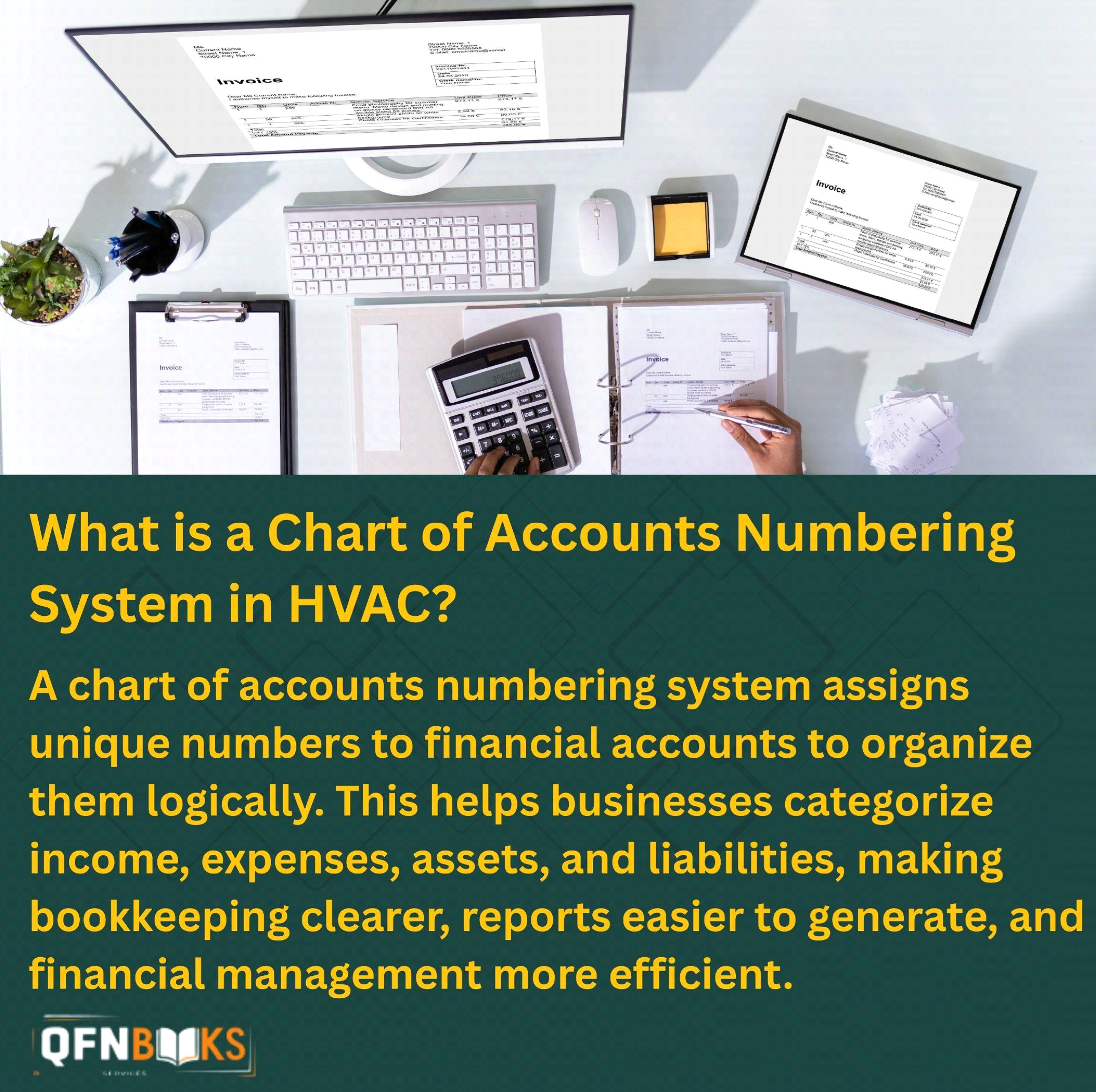
In HVAC bookkeeping, a chart of accounts (COA) numbering system is used to group financial activity into categories that match how your business operates.
Each account, like labor costs, equipment sales, or truck expenses, gets a number that shows where it fits.
For example:
- 4000 series = Income (like 4100 for Install Revenue, 4200 for Service Revenue)
- 5000 series = Job Costs (like 5100 for Labor, 5200 for Materials)
- 6000 series = Operating Expenses (like 6100 for Vehicles, 6200 for Marketing)
This numbering system keeps your books clean and makes it easier to sort, filter, and report on financial data, especially when you’re working across multiple service types or teams.
2. Why HVAC Businesses Require Industry-Specific Structures
HVAC companies earn income in different ways, from installations and service calls to planned maintenance and product sales. A one-size-fits-all chart won’t capture this detail.
With an HVAC-specific structure, you can track each income stream and its related costs separately, giving you a clearer picture of profitability.
3. How a Good COA Supports Job Costing and Financial Visibility
A smart COA lets you break down every job by the costs that matter, labor, parts, subcontractors, and equipment. This supports accurate job costing and lets you track profit per job, service type, or department.
It also helps you monitor trends, catch overspending early, and make better business decisions. A solid bookkeeping numbering system creates clear financial structure and accurate job costing.
Next, learn how to build an HVAC chart of accounts that tracks details clearly and grows with your business.
Helpful Resource → Bookkeeping for Startups: Building Financial Clarity from Day One
How to Build an Effective HVAC Chart of Accounts
Setting up your HVAC chart of accounts (COA) correctly from the start makes a huge difference.
A structured COA helps you track revenue, control costs, and understand how each part of your business is performing.
The key is to use clear number ranges, leave space for future growth, and organize accounts in a way that reflects how your team actually works.
1. Standard Number Ranges Used in Accounting
In bookkeeping, accounts are grouped using standard number ranges. These ranges help keep your books organized and easy to read:
- 1000–1999: Assets (Cash, Equipment, Accounts Receivable)
- 2000–2999: Liabilities (Credit Cards, Loans, Accounts Payable)
- 3000–3999: Equity (Owner’s Equity, Retained Earnings)
- 4000–4999: Income (Installs, Service, Maintenance)
- 5000–5999: Cost of Goods Sold (Labor, Parts, Subcontractors)
- 6000–6999: Operating Expenses (Rent, Fuel, Marketing)
Using this format gives you a predictable structure, which is especially useful when reviewing financial reports or working with a CPA.
2. Why Number Gaps and Subaccounts Are Essential
Leave number gaps between accounts so you can add new categories later without needing to reorganize everything. For example, use 4100 for “Install Revenue,” and leave space for 4110 “High-Efficiency Installs” or 4120 “Retrofits.”
Subaccounts help break down major categories. Under “Vehicle Expenses,” you might have:
- 6100.01 Fuel
- 6100.02 Maintenance
- 6100.03 Insurance
This gives you more detailed tracking without overwhelming your books.
3. Structuring by Department or Team
Larger HVAC companies often have multiple departments or service lines, like residential installs, commercial service, or maintenance plans. Structuring your COA by department lets you track each division’s performance.
You can assign number blocks to each department. For example:
- 4200–4299: Residential Service Income
- 4300–4399: Commercial Install Income
This helps you create department-specific reports and make smarter growth decisions.
4. Including MESO and Overhead Accounts
HVAC jobs often involve MESO costs, Materials, Equipment, Subcontractors, and Other job-related expenses.
These should be tracked separately from overhead. Set clear categories like:
- 5200: Materials
- 5300: Equipment Rentals
- 5400: Subcontractors
- 5500: Permits and Other Costs
Also, split overhead into fixed (like rent and salaries) and variable (like fuel or marketing) so you can understand what scales with volume and what doesn’t.
A well-structured HVAC chart of accounts provides a clear, flexible framework for tracking financial details by department, job costs, and overhead.
With this foundation in place, let’s explore common bookkeeping practices that ensure accurate categorization of income and expenses, improving profitability and financial clarity.
Common Bookkeeping Practices in HVAC Businesses

Understanding how to categorize income and expenses in HVAC bookkeeping helps keep your financials clear and useful.
Knowing what to track and where makes job costing accurate and improves your ability to measure profitability.
1. Revenue Categories Used in HVAC
HVAC businesses earn money from several sources. Common revenue accounts include:
- Service calls
- Installations
- Maintenance contracts
- Equipment sales
Tracking these separately lets you see which services bring in the most income and which may need more attention or pricing adjustments.
2. Cost of Goods Sold Categories
Cost of goods sold (COGS) covers all the direct expenses tied to completing jobs:
- Labor costs for technicians
- Parts and materials used
- Subcontractor fees
- Equipment rentals
Correctly tracking COGS is crucial for understanding gross profit and pricing jobs appropriately.
3. Operating Expense Accounts
Operating expenses are the costs to run your business, but aren’t directly tied to jobs. Common accounts include:
- Vehicle expenses
- Tools and equipment
- Office costs (rent, utilities)
- Marketing and advertising
- Dispatch and scheduling
Separating these helps control overhead and identify areas to reduce costs.
4. Tracking Job Costs and Department Performance
A detailed chart of accounts allows you to track costs and revenue by job and department. This helps measure gross margins accurately and identify profitable or loss-making jobs.
Using departmental profit and loss statements (P&Ls) gives deeper insight into which parts of your business are thriving and which may need improvement.
This data supports better decisions and helps scale your HVAC company confidently.
Clear bookkeeping practices lay the foundation for accurate job costing and financial insight.
But to get the most from your data, your chart of accounts needs a numbering system that matches how your HVAC business actually runs.
Let’s look at the different COA structures HVAC companies use and how to choose the best fit.
Different Numbering Systems Used by HVAC Businesses

The right chart of accounts (COA) numbering system helps HVAC businesses stay organized and make better financial decisions. Depending on your size, structure, and software, different approaches can work best.
- Using Pre-Built Accounting Templates
Templates from tools like QuickBooks or FreshBooks are easy to set up and work for basic needs, but they often miss HVAC-specific details. You can customize them, but it takes time and expertise. - Custom Numbering for Complex Operations
Larger businesses, franchises, or multi-crew operations often need custom numbering. This lets you organize accounts by job type, team, or location, great for tracking performance and controlling costs. - Matching Your COA to Your Business Model
Whether you do residential, commercial, or both, your COA should reflect your service mix. This ensures accurate reporting and insights.
A well-matched numbering system gives you the clarity and flexibility needed to grow your HVAC business with confidence.
Choosing the right COA structure is key, but even the best system can fall short if common bookkeeping challenges go unaddressed.
Let’s explore the issues HVAC owners face and how to overcome them.
Common Bookkeeping Concerns HVAC Owners Have
Many HVAC owners face bookkeeping issues that hurt profitability and cash flow. Tackling these concerns improves financial clarity and supports smarter growth.
- Lack of Job-Level Profitability Tracking
Without detailed job costing, it’s hard to see which jobs are profitable, leading to underpricing or hidden losses. - Strong Revenue, Weak Cash Flow
Good sales don’t always mean healthy cash flow. Late receivables or unchecked overhead can create financial stress. - Overhead Costs Draining Profits
Expenses like rent, insurance, and utilities quietly eat into margins, especially when fixed vs. variable overhead isn’t tracked separately. - Service vs. Install Not Separated
These functions have different costs and margins. Tracking them separately leads to better pricing and forecasting.
Recognizing these common issues is the first step toward building a more accurate, strategic, and scalable HVAC bookkeeping system. If these challenges are holding your business back, it may be time to bring in expert help.
Outsourcing your HVAC bookkeeping can free up time and ensure your financials stay accurate as you grow.
When to Outsource Your HVAC Bookkeeping
Outsourcing bookkeeping can save time and improve accuracy, especially as your HVAC business grows or becomes more complex.
Here’s when and why to consider hiring a professional.
- Signs You Should Outsource:
- Struggling to keep up with bookkeeping tasks
- Managing multiple service lines or locations
- Experiencing rapid business growth
- Limited time to focus on financials
- Benefits of Hiring HVAC-Focused Accountants:
- Expertise in HVAC-specific costs and key performance indicators (KPIs)
- More accurate job costing and financial reporting
- Faster turnaround and timely insights for decision-making
- How to Choose the Right Bookkeeping Partner:
- Familiarity with your bookkeeping software (e.g., QuickBooks, ServiceTitan)
- Experience working with HVAC or trade businesses
- Positive references and proven track record of results
Outsourcing bookkeeping can help you focus on growing your business while ensuring your financial data is reliable and up-to-date.
Getting your bookkeeping right starts with a strong foundation. Here’s how to get started with your HVAC chart of accounts.
How to Get Started with Your HVAC Chart of Accounts
Starting with a clear and organized chart of accounts (COA) is essential for smooth bookkeeping in your HVAC business. A well-designed COA helps you track all financial activities properly and gives you a better understanding of your company’s performance.
Here’s how you can set it up:
- Assign number ranges for major categories like assets, liabilities, income, and expenses.
- Include subaccounts for detailed tracking such as labor, materials, and overhead costs.
- Leave gaps between numbers to allow room for future additions.
- Organize accounts by departments or service types to simplify reporting and analysis.
Regularly review and update your COA to keep it aligned with your business needs.
If you find it confusing or time-consuming, don’t hesitate to seek expert help. A customized COA tailored to your HVAC operations can save time, reduce errors, and support your growth goals.
Final Thoughts on Building a Better Bookkeeping System
A well-organized chart of accounts is more than just numbers; it’s a strategic asset that helps HVAC businesses gain clarity and control over their finances.
Structured bookkeeping enables better decision-making, accurate job costing, and smoother growth.
Investing time and effort in your bookkeeping system pays off by giving you clear financial visibility and confidence.
If you want to ensure your HVAC company’s accounting and bookkeeping meet industry standards, consider partnering with experts who understand your business.
For reliable, professional bookkeeping tailored to HVAC companies, contact QFN Books.
Our team delivers accurate, timely financial management so you can focus on growing your business.
FAQ 1: What is a bookkeeping numbering system for HVAC companies?
A bookkeeping numbering system assigns numbers to income, costs, and expenses in your HVAC chart of accounts. It organizes financial data for clear tracking of jobs, departments, and overhead, improving accuracy and simplifying financial management.
FAQ 2: Why do HVAC companies need an industry-specific chart of accounts?
HVAC businesses have diverse revenue streams like installs, service calls, and maintenance. An industry-specific chart of accounts separates these income types and related costs, providing clearer profitability insights and better financial control.
FAQ 3: How does job costing improve HVAC business profitability?
Job costing tracks labor, materials, and overhead for each job, helping HVAC companies identify profitable projects and control costs. Accurate job costing prevents underpricing and uncovers areas for improving efficiency and margins.
FAQ 4: What are common bookkeeping challenges for HVAC businesses?
HVAC owners often struggle with tracking job-level profitability, managing cash flow, and controlling overhead costs. Separating service and install revenues and regularly reviewing accounts can help solve these common financial challenges.
FAQ 5: When should HVAC businesses outsource bookkeeping?
Outsource bookkeeping when tasks become overwhelming, you have multiple service lines or locations, or experience rapid growth. HVAC-focused accountants offer expertise, accurate job costing, and timely financial insights, freeing you to focus on business growth.